5 Best Passport Photo Maker Tools and Studio Services in 2026
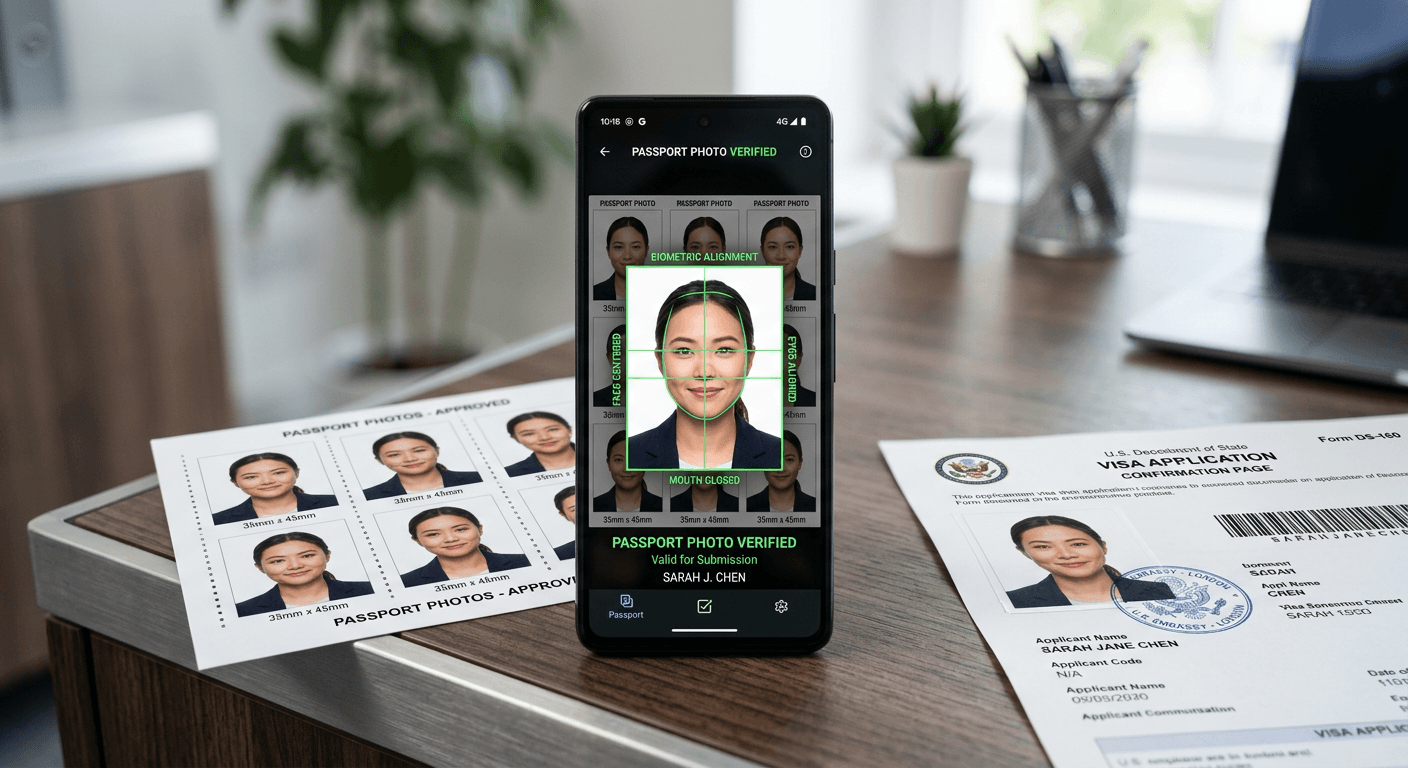
Most applicants assume a rejected biometric photograph is a failure of lighting or contrast, but it is almost always a failure of geometry. Government scanners evaluate the exact distance between the chin and the crown of the head, the centering of the eyes, and the precise pixel density of the background. A reliable passport photo maker does not merely apply a filter; it maps the face to a rigid grid before formatting the file for specific consular standards.
The landscape of document processing has fundamentally shifted. Software applications now validate biometric constraints in real-time on consumer devices, while legislative changes dictate how those files reach government servers. Evaluating these tools requires separating platforms that merely crop an image from those that integrate directly with official administrative systems.
Quick Summary
A digital passport photo generator is an application or kiosk that standardizes portraits to meet government biometric requirements, managing head size, background color, and printing templates. The market splits between self-service applications and professional studios equipped for direct institutional transmission.
- Legal shifts: German regulations effective May 2025 invalidate self-printed application photos for official domestic IDs.
- Digital transmission: Professional studios now route images directly to authorities via secure protocols.
- Retail kiosks: Drugstore chains remain viable for generating cheap templates for foreign visas.
- Software validation: AI-driven apps pre-check proportions before you pay for printing or digital downloads.
Table of Contents
- Buying Guide: How to Choose a Fulfillment Method
- Comparison Table
- 1. dm-drogerie markt
- 2. PicturePeople
- 3. CEWE Passfoto App
- 4. ROSSMANN Fotowelt
- 5. PhotoAiD
- Choosing the Right Category for Your Document
- Recommended Reads
Buying Guide: How to Choose a Fulfillment Method
The capability of these services is defined entirely by where the data ends up. A high-resolution print is useless if the consulate mandates a direct secure upload. To compare these solutions accurately, we must classify them along their primary Fulfillment Method.
Retail Kiosk & App These solutions pair a mobile application with physical printing hardware located in regional drugstores. The user captures the image on a smartphone, uses the application to verify the biometric grid, and receives a unique code. They then travel to a physical kiosk to print the file on standardized photographic paper. Many families search for passfoto machen in der nähe to locate these terminals because they offer physical outputs without the markup of a dedicated photographer. They are highly effective for foreign visas that still require stapled or glued paper photographs.
Full-Service Studio These are physical locations staffed by photographers operating dedicated lighting rigs and professional cameras. They capture, validate, and process the image on-site. Crucially, they possess the commercial software required to establish secure, encrypted data connections with domestic government agencies. This infrastructure is necessary for compliance with stringent new domestic identity laws, ensuring the file is never tampered with between capture and submission. If you are examining the Germany baby passport photo requirements, understanding this secure transmission pipeline is critical.
Digital-Only Platform These software ecosystems exist entirely on smartphones or web browsers. They process raw images through artificial intelligence to strip out unapproved backgrounds, resize the canvas, and verify facial proportions against specific country databases. They return a digital passport photo file suitable for online visa portals. They lack native printing hardware, relying on the user to either upload the file digitally or seek out a third-party printer.
Comparison Table
| Product | Fulfillment Method | Features | Pros | Cons | Target Audience |
|---|---|---|---|---|---|
| dm-drogerie markt | Retail Kiosk & App | In-store printing, app integration | No in-app payment, fast local printing, low €5.95 base cost | Invalid for German IDs post-May 2025, requires travel, potential queues | Visa applicants needing rapid physical prints |
| PicturePeople | Full-Service Studio | Direct government transmission, booking system | Guaranteed compliance, professional lighting, direct routing | High €24.99 cost, requires appointments, limited locations | Citizens renewing official German passports or IDs |
| CEWE Passfoto App | Retail Kiosk & App | Biometric checks, 4000+ stations | Wide network, software validation, dedicated support line | Invalid for German IDs post-May 2025, app learning curve, manual pickup | Users applying for foreign travel documents |
| ROSSMANN Fotowelt | Retail Kiosk & App | Online delivery, 12.6x12.6cm templates | Ultra-cheap €0.27 template prints, online ordering option, accessible | Demands manual layout skills, separate shipping costs online, not automated | Budget-conscious users comfortable with manual formatting |
| PhotoAiD | Digital-Only Platform | AI background removal, international formats | Refund guarantee, multi-country support, immediate digital delivery | iOS app limitation in sources, no native physical kiosks, DIY printing required | Remote applicants needing foreign visa files quickly |
1. dm-drogerie markt
Applicants often realize they lack a compliant photograph hours before a scheduled consulate appointment, prompting a frantic search for immediate physical printing. dm-drogerie markt operates as a Retail Kiosk & App solution, merging a smartphone preparation tool with in-store hardware.
The dm-Passbild-App requires no upfront in-app payment. Users take a photograph against any background, and the application adjusts the proportions. Once the file is formatted, the user visits a physical dm-Markt location. If printed from the app's output at the store, a dm passport photo costs €5.95. Alternatively, utilizing the on-site passport photo services to shoot and print a set of six biometric pictures directly at the terminal costs €7.95. The transaction is finalized at the store checkout rather than through a digital gateway. For navigating the specific framing rules of foreign nations, consulting a UK baby passport photo guide beforehand prevents terminal errors.
The application bridges the digital-to-physical gap but carries a strict expiration date
The utility of this hybrid model collapsed for domestic administrative use following a legislative overhaul. Since May 1, 2025, self-made photos generated from the app can no longer be utilized for official German passports, ID cards, or electronic residence permits due to German legal changes mandating direct secure transmission.
I would skip this route for official domestic identity renewals after the deadline, but it remains an excellent choice for foreign visas where consulates still demand physical paper attachments.
Pros
- No payment is required within the mobile application.
- App-prepared prints carry a low base price of €5.95.
- On-site kiosk services are widely available across Germany.
Cons
- Self-created images are invalid for German domestic documents as of May 2025.
- Fulfillment requires traveling to a physical retail location.
- Wait times vary based on in-store hardware availability.
2. PicturePeople
Removing the risk of rejection entirely requires surrendering control over the capture process to trained operators. PicturePeople functions as a Full-Service Studio, maintaining a network of physical branches staffed by professional photographers across Germany.
The mechanism here is entirely outsourced. Customers can book appointments online or by phone to avoid waiting times. The studio captures the image under controlled strobes, ensuring the absence of shadows on the background or face. Crucially, they offer legally compliant, secure digital transmission of the images directly to German authorities, satisfying the regulations effective starting May 1, 2025. A standard set of six printed biometric photographs (3.5x4.5 cm) costs €24.99, while special passport formats incur an additional surcharge of €5. You can read more about how studios handle biometric data retention in a standard privacy policy.
Direct digital transmission replaces the physical print entirely
The €24.99 standard cost and the requirement to physically commute to a studio branch restrict this option for high-volume, low-stakes applications. It is an over-investment for a recreational sports pass or a secondary student ID.
This is the environment to choose when navigating the May 2025 legal changes makes you nervous about self-service kiosks and you require absolute, guaranteed compliance.
Pros
- Compliant with May 2025 secure digital transmission regulations.
- Online booking system eliminates unpredictable queue times.
- Professional studio lighting prevents rejection due to shadow or contrast issues.
Cons
- Base cost of €24.99 is significantly higher than kiosk alternatives.
- Special formats require a €5 surcharge.
- Restricted to the operating hours and geographic footprint of the studios.
3. CEWE Passfoto App
Checking biometric validity at the kiosk wastes time if the source image is fundamentally flawed. CEWE Passfoto App addresses this bottleneck by pushing the validation process onto the user's mobile device before they ever leave their home.
Operating within the Retail Kiosk & App category, the software features an integrated biometric check. The application analyzes the smartphone camera feed, verifying that the framing, head rotation, and eye alignment meet international standards for both biometric and non-biometric documents. Once verified, the file is routed to one of over 4,000 CEWE Fotostations located at participating retail partners throughout Germany. Users with technical issues can reach customer support at +49 441 18131911. Reviewing an international baby passport photo guide helps clarify which biometric standard to select in the app before initiating the scan.
Software validation reduces physical kiosk anxiety
The legislative ceiling applies just as firmly here as it does to its competitors. Starting May 1, 2025, self-created photographs processed via this software are no longer valid for official German identity cards, passports, or residence permits.
This platform suits applicants compiling non-biometric identification or foreign visas, provided they live near a participating retail partner with operational printing hardware.
Practical rule: Never select a glossy paper finish at a retail terminal unless the consulate explicitly demands it; matte finishes prevent scanner glare at border control and reduce the risk of immediate rejection.
Pros
- Integrated software checks biometric requirements before you travel.
- Massive footprint of over 4,000 printing stations nationwide.
- Dedicated telephone support line for application troubleshooting.
Cons
- Output cannot be used for German passports following the May 2025 regulations.
- Requires navigating a third-party retailer's physical hardware.
- Print quality relies heavily on the maintenance schedule of the local Fotostation.
4. ROSSMANN Fotowelt
Many families look for a passport photo online free tool to generate a compliant layout file, intending to print it themselves for pennies rather than paying a premium. ROSSMANN Fotowelt acts as a Retail Kiosk & App avenue that facilitates exactly this kind of aggressive budget optimization.
The service separates digital ordering from physical fulfillment. If you prefer delivery, ordering a standard four-photo set online starts at €2.99, though this excludes shipping costs. The primary mechanism for cost-saving, however, relies on the physical kiosks. The standard printed biometric size is 3.5 x 4.5 cm. If an applicant uses external software to arrange multiple 3.5 x 4.5 cm frames onto a single 12.6 x 12.6 cm format layout, they can print that pre-formatted template on-site at a Rossmann CEWE-Fotostation for just €0.27 per print. If you encounter issues formatting these specific grids, checking an external help center can provide clarification on standard DPI outputs.
Template printing requires rigorous upfront layout preparation
The platform provides the physical print at an exceptionally low €0.27 rate, but it demands the user possess the technical skill to build the 12.6 x 12.6 cm template independently. The terminal will simply print the file it receives; it will not automatically arrange a single portrait into a compliant multi-photo grid at that price point.
I would hold off on this approach if you lack dedicated photo editing software, as an incorrectly scaled layout will result in heads that are mathematically too small for government scanners.
Pros
- Template printing at the terminal costs only €0.27.
- Online ordering option starts at a low €2.99 base price.
- Supports custom layouts on the 12.6 x 12.6 cm format.
Cons
- Requires external software to build the cheap printing templates.
- Online delivery prices do not include the cost of shipping.
- In-store terminal interfaces can be complex for first-time users.
5. PhotoAiD
Automating the background removal process is the only way to process identification images consistently without a physical photography studio. PhotoAiD belongs to the Digital-Only Platform category, using machine learning to manipulate pixels directly on a mobile device.
The software strips the environment from the image. Available as a mobile app for iOS devices, it replaces the background with a uniform color. It also resizes the portrait. The tool supports formatting for non-German documents, specifically accommodating the complex square ratios required for Indian Visa and US Visa applications. The platform operates without human photographers. It mitigates risk by offering users a refund if the processed image is ultimately rejected by authorities. When applying for foreign entry, consulting a US baby passport photo guide confirms the exact pixel dimensions the AI should be outputting.
Automated processing targets the international visa market
The ecosystem operates entirely within iOS and lacks integrated physical print kiosks within domestic retail chains. Users receive a digital file and must independently source a printer if the consulate demands a hard copy.
This is the tool to choose when applying for a foreign digital visa from your smartphone, provided you do not require an immediate, integrated physical print.
Practical rule: Always request the uncompressed JPEG file from a digital platform; compressing the image via email or messaging apps destroys the pixel density required by official government upload portals.
Pros
- Automatically formats dimensions for international visas (US, India).
- Offers a refund policy for images rejected by authorities.
- Processes files entirely on the user's iOS device.
Cons
- Sources indicate the app is limited to iOS devices.
- Lacks integrated physical kiosk printing.
- User is responsible for sourcing their own compliant photographic paper.
Choosing the Right Category for Your Document
The document you are applying for dictates the tool you must use. Matching your specific situation to the correct Fulfillment Method prevents costly delays and bureaucratic rejections.
If you are renewing an official German passport or national identity card after May 2025, you must select a Full-Service Studio. The legal requirement for secure, direct digital transmission to authorities eliminates DIY applications. Studios possess the cryptographic keys and software routing necessary to push your biometric data directly to the citizen's office, entirely bypassing the need for paper.
If your bottleneck is securing physical attachments for a foreign visa application, a Retail Kiosk & App is the optimal choice. Consulates outside the domestic digital network still require 3.5 x 4.5 cm prints glued to paper forms. Using an application to verify the geometry, followed by a trip to a local drugstore terminal, keeps costs low while ensuring the physical photograph meets standard international parameters.
If you are applying for an electronic travel authorization (eTA) or a digital-first international visa, a Digital-Only Platform provides the most streamlined route. These systems format the specific pixel ratios demanded by foreign upload portals, stripping backgrounds instantly and returning a file that will clear automated consular scanners without the friction of visiting a physical store.