5 Options for British Passport Renewal and US Applications in 2026
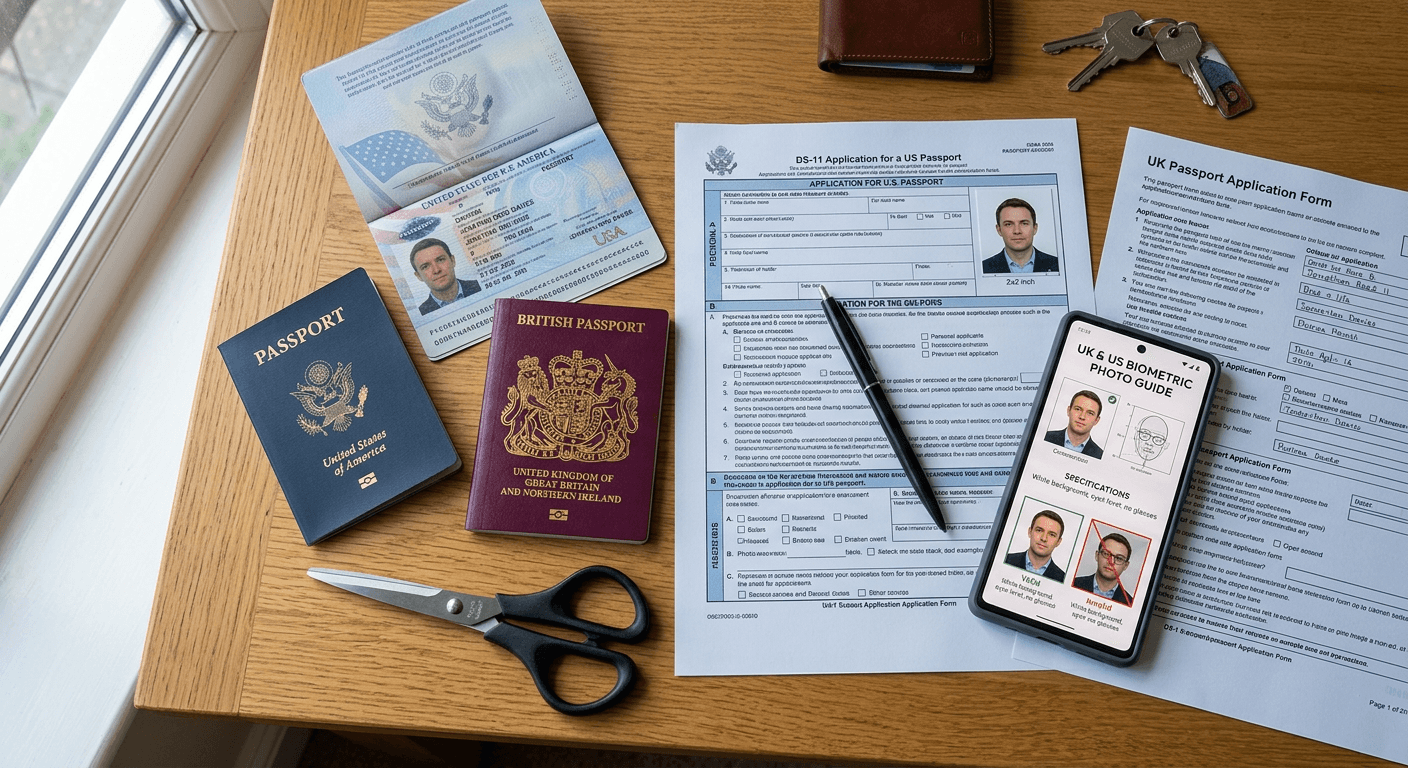
Overseas standard paper-based adult passport applications cost £130 through official channels, but the hidden cost of a rejected photograph or a missing counter-signature often means paying that fee twice. Handling a british passport renewal or a transatlantic document update from Germany requires navigating a maze of conflicting postal standards, rigid biometric constraints, and inflexible government processing queues. Expatriates frequently assume that applying from abroad simply means mailing an envelope to a different address. In reality, cross-border renewals introduce an entirely separate layer of logistics where a single unpadded envelope or an incorrect courier label triggers a complete rejection, resetting the bureaucratic clock back to day one.
Quick Summary
Renewing a UK or US travel document from Germany involves choosing between direct government submissions and mediated independent services that manage international logistics. The right path depends entirely on whether you have the time to absorb a potential rejection and the patience to manage cross-border postal requirements yourself.
- Direct submissions carry the lowest base fees but transfer all administrative risk to the applicant.
- Independent agencies front-load compliance checks, intercepting biometric failures before they reach the government.
- Fast-track facilitators prioritize transit speed, leveraging private courier networks to bypass standard postal hand-offs.
- Strict physical formatting rules, such as specific envelope sizes, remain non-negotiable across all official channels.
Table of Contents
- Buying Guide: Assessing the Commercial Model
- 1. His Majestys Passport Office
- 2. U.S. Embassy and Consulates in Germany
- 3. MyBritishPassport
- 4. U.K.ABROAD
- 5. ASAP Passports
- Matching Your Constraints to the Right Pathway
- Recommended Reads
Buying Guide: Assessing the Commercial Model
Before analyzing specific providers, you must define the Commercial Model separating these solutions. A passport renewal is fundamentally a data transfer problem governed by strict legal parameters. The available avenues diverge based on who assumes the risk of formatting errors and who handles the physical transit of supporting documents.
First, Direct Government Services operate without intermediaries. These are the foundational portals operated by sovereign states. They offer the lowest financial barrier to entry, but they demand absolute compliance. If you misunderstand a digital prompt or submit a photograph with incorrect dimensions, the system will silently fail you weeks later. You assume total liability for understanding the instructions.
Second, Independent Assistance Agencies function as administrative buffers. These businesses charge a service margin to pre-check your forms and biometrics against government standards before the official submission occurs. By checking the specific international baby passport photo requirements or verifying your identity documents in advance, they prevent the dreaded application reset. They sell certainty, not necessarily speed.
Finally, Fast-Track Facilitators focus heavily on logistics. While they cannot command a foreign government to process a file faster, they compress the dead time your application spends languishing in postal sorting hubs. They utilize established cross-border courier relationships to maintain a tight chain of custody over your original identity documents.
Practical rule: Never measure an intermediary's processing speed from the moment you hand them the documents; measure it from the moment they officially lodge the verified package with the government.
1. His Majestys Passport Office
Submitting documents directly to the source removes intermediate markups. The official UK government department responsible for processing and issuing British passports globally dictates the ultimate rules of the game, receiving physical documents directly from citizens renewing from abroad without third-party fees.
Buyers focusing on Direct Government Services will find this route bypasses intermediaries entirely, meaning it should not be compared against concierge services that hold your hand through the paperwork. The digital mechanism requires applicants to submit their data via the GOV.UK portal, upload a digital photograph, and nominate an eligible individual for a digital counter-signature if the system demands it. Once the online framework accepts the data, the applicant must physically mail their old passport and any supporting civil documents directly to a designated processing center in the United Kingdom.
Bureaucratic directness transfers all error risk to the applicant
Handling a uk passport renewal directly through this interface leaves zero margin for logistical misunderstandings. Overseas standard paper-based applications carry distinct baseline fees depending on whether they are for a child or an adult. Regardless of the format chosen, the system relies heavily on automated initial checks that provide minimal constructive feedback. If your digital photograph fails the background extraction test, or if your nominated counter-signatory ignores the automated email prompt, your application halts entirely.
This pathway lacks proactive pre-submission validation. If you send a package containing a damaged birth certificate or an improperly cut photograph, the processing center will not notify you immediately. The package sits in the queue, reaches an adjudicator, fails the visual inspection, and triggers a rejection letter that takes days to arrive back in Germany. This resets the processing clock entirely. I would hesitate to use the paper-based route here, as the digital pathway provides at least basic dimensional validation checks during the photo upload stage, catching obvious errors before money changes hands.
Opt for this route if your application is straightforward, your biometrics are pristine, and you are entirely comfortable managing international document shipping yourself.
Pros
- Avoids third-party service margins entirely.
- Provides immediate digital routing to the correct UK sorting office.
- Integrates directly with the digital counter-signature system.
Cons
- Offers zero personalized feedback on application anomalies.
- Demands the applicant manage their own cross-border courier tracking.
- Rejects non-compliant packages silently, causing massive delays.
2. U.S. Embassy and Consulates in Germany
Mail-in applications remove the applicant from physical consular lines by pushing the identity verification burden onto strict physical document standards. For resident U.S. citizens, the official diplomatic mission representing the United States in Germany handles mail-in adult passport renewals without requiring physical attendance.
By utilizing Direct Government Services, applicants eliminate third-party margins but must accept a process that demands strict adherence to local logistics. Do not compare this to assisted digital processing; you are entirely on your own regarding the paperwork assembly. The mechanism revolves around Form DS-82. This form must be printed on single-sided paper, as double-sided forms are not accepted by the intake scanners. Applicants assemble the single-sided form, their most recent passport, a compliant physical photograph, and the application fee into a specific mailing configuration directed at the consulate.
Physical formatting constraints replace in person consular appointments
Submitting Form DS-82 by mail for an adult U.S. passport book renewal incurs a standard processing charge. However, the true friction lies in the mandatory return logistics. Mail-in applicants must provide a pre-paid DHL ExpressEasy shipping label affixed to a DIN C5 unpadded envelope for passport return delivery. The average processing time for a routine mail-in adult passport renewal received by the Frankfurt Consulate is 6 weeks, assuming every piece of paper aligns perfectly with these stipulations.
The rigid requirement for specific German postal products creates an immediate failure point for expatriates unfamiliar with local mailing standards. If you purchase the wrong envelope size, affix standard stamps instead of the required DHL ExpressEasy label, or submit a double-sided application form, the mailroom will reject the package upon arrival. What would make me hold off on this specific mail-in route is if the applicant's current passport is severely damaged or mutilated, which voids the DS-82 eligibility and forces an in-person appointment regardless of how perfectly the envelope is prepared.
Choose this avenue when replacing an undamaged 10-year validity book and you have easy access to German postal logistics.
Pros
- Eliminates the need to travel to a physical consulate in Germany.
- Returns the canceled older passport directly to the applicant.
- Keeps financial costs strictly to official government fees.
Cons
- Mandates a highly specific combination of German postal products.
- Rejects double-sided prints without exception.
- Offers no digital pre-check for the physical photograph.
3. MyBritishPassport
The threat of an expired travel document ahead of scheduled international flights pushes expatriates toward mediated solutions. Expatriates looking to offload the friction of document checks and secure shipping turn to this independent service provider to manage their applications from Germany.
Operating within the Independent Assistance Agencies category, this provider inserts a commercial buffer between you and the state. It should not be compared to direct government channels on price, but rather on risk reduction. The mechanism begins with a digital intake where staff manually review the application forms and photographs against official Home Office standards. Only after the compliance agents verify that every margin, signature, and date aligns with the rules does the company instruct the applicant to dispatch the physical supporting documents. The agency then routes the package via secure courier networks to the UK, managing the tracking process internally.
Mediated submissions trade service margins for compliance security
For a straightforward overseas renewal from Germany, the company advises allowing approximately 3 to 4 weeks. This timeline relies heavily on their ability to intercept errors before the government sees them. By catching an incorrectly sized photograph or a missing section in the application form early, they prevent the dreaded reset of the government's internal processing clock. They take the raw requirements and translate them into actionable, verified steps.
The added review layer fundamentally increases the overall financial outlay. This service stops being useful if you have a flawless track record of self-managed renewals and are simply looking to save money on courier fees. I would opt out of this tier if I were only updating a simple name change with zero travel planned for the next six months, as the premium paid for preliminary document screening outweighs the urgency.
Rely on this intermediary when the cost of a delayed rejection heavily outweighs the premium paid for administrative certainty.
Pros
- Intercepts biometric and formatting errors prior to official submission.
- Manages secure courier routing to the United Kingdom.
- Provides a reliable estimated timeframe based on current queue data.
Cons
- Adds a distinct service fee on top of government passport costs.
- Requires the applicant to trust a third party with highly sensitive data.
- Still relies on the applicant to source correct physical documents.
4. U.K.ABROAD
Unlike direct submissions that leave you guessing until a rejection arrives, this pathway front-loads the verification. Replacing the raw government interface, this independent service provider guides British citizens overseas through renewals, replacements, and first-time applications using automated pre-checks.
Also positioned in the Independent Assistance Agencies category, this platform operates as a structural translator. You cannot weigh it against fast-track couriers, as its primary value is administrative accuracy rather than raw transit speed. The platform pushes applicants through a proprietary portal that strips away confusing government jargon. Completing the online application form on their website takes approximately 10 to 15 minutes. This digital intake structures the data collection, forcing the applicant to provide information in the exact format the government adjudicators expect, before human agents conduct a final review.
Proprietary intake forms shield applicants from raw government interfaces
By decoupling the applicant from the raw GOV.UK portal, the service minimizes user error. They ensure that all supporting documentation aligns precisely with the legal prerequisites. For families securing travel documents for infants, following a strict Germany baby passport photo guide becomes easier when an agent confirms the background color is correct before the package leaves the house.
The service strictly requires applicants to have a current passport that is valid or has expired within the last 10 years to be eligible for standard renewal. If your document lapsed a decade ago, their standard digital pipeline will not accept your case, forcing you into a significantly more complex manual application process. I would certainly hesitate to use this specific portal if I held complex dual-citizenship documentation that requires bespoke consular advice, as streamlined portals are built for standard paths, not edge cases.
This solution makes sense for users who want to outsource the procedural friction of formatting checks and demand a simplified digital interface.
Pros
- Reduces application data entry to a guided 10-to-15 minute process.
- Translates complex government requirements into plain language.
- Verifies all inputs before triggering physical document shipping.
Cons
- Locks out applicants whose passports expired more than 10 years ago.
- Charges a premium for interface simplification.
- Cannot assist with highly complex, non-standard citizenship disputes.
5. ASAP Passports
How do you bridge the gap between an impending travel date and a foreign postal system? When severe time constraints hit, citizens residing in Germany rely on this private passport assistance agency to push fast-track renewals through international postal delays.
Representing the Fast-Track Facilitators category, this operation focuses heavily on transit compression. Comparing this to standard independent agencies misses the point; it is built entirely around overcoming postal lag. The agency leverages localized knowledge and established courier relationships to expedite the physical transit of original documents across borders. For anyone attempting a uk renew passport application at the last minute, the service bypasses the standard hand-offs between Deutsche Post and the Royal Mail, keeping the sensitive documents in a single, tracked chain of custody until they hit the official processing desk.
Logistics acceleration mitigates the friction of cross border postal delays
Crossing the English Channel with original identity documents is a high-stakes logistical exercise. By utilizing point-to-point courier networks, this service minimizes the dead time standard applications spend sitting in international transit networks. They track the physical package down to the precise sorting desk at the UK facility, providing a level of physical oversight that standard mail cannot match.
This service cannot alter the internal processing queues of the government office itself. If the Home Office is facing severe seasonal backlogs, expediting the shipping only hurries your documents into a stationary queue. It only shrinks the transit window on either end of the journey. I would skip this premium tier entirely during off-peak winter months when standard government turnaround times are already historically swift and standard couriers face no seasonal logistics bottlenecks.
Reserve this option for critical time constraints where shaving days off the shipping transit window is financially justified by your travel schedule.
Pros
- Compresses international transit times via private courier networks.
- Eliminates standard postal hand-offs at national borders.
- Provides granular tracking for original identity documents.
Cons
- Carries a high price point for logistical acceleration.
- Remains entirely dependent on internal government processing speeds.
- Offers diminishing returns during off-peak government processing seasons.
Matching Your Constraints to the Right Pathway
Selecting the correct avenue comes down to evaluating your tolerance for administrative risk against your willingness to pay service margins.
If your primary constraint is financial and you are comfortable parsing rigid bureaucratic instructions, Direct Government Services remain the logical choice. By managing the exact envelope dimensions for a US application or handling the digital counter-signature for a UK submission yourself, you avoid all intermediary fees. This path demands flawless execution, as the government will silently reject non-compliant packages.
If your bottleneck is administrative friction, Independent Assistance Agencies provide the necessary buffer. By translating complex government jargon into guided 15-minute portals and intercepting biometric failures before they cross borders, these services trade a financial premium for compliance security. They suit expatriates who cannot afford the weeks lost to a rejected application.
If your defining challenge is a rapidly approaching flight date, Fast-Track Facilitators offer the specific logistical acceleration required. While they cannot command the government to work faster, compressing the cross-border transit time ensures your documents spend the maximum possible time on an adjudicator's desk rather than in a sorting facility.