Navigating the Emergency German Passport Process Before Travel
Imagine standing at the check-in counter at Frankfurt Airport, reaching into your travel wallet, and discovering your child's passport has a massive water stain obscuring the machine-readable zone. The airline staff shakes their head - you are not boarding today. This specific panic dictates your next 24 hours. Navigating the German bureaucratic system to secure a vorläufiger reisepass requires exact documentation, physical presence, and proof of absolute urgency. You cannot simply walk into an office and demand a document; you must prove why the standard printing timeline at the Bundesdruckerei will cause you to miss a paid departure.
Quick Summary
A vorläufiger reisepass is a green-covered, temporary emergency travel document issued by German authorities when a standard passport cannot arrive in time for imminent travel. It is valid for up to one year but lacks the biometric e-chip required for visa-free entry to certain countries.
- Must be requested in person at a Bürgeramt with proof of imminent travel.
- Requires a newly captured, strictly compliant 35x45 mm biometric photograph.
- Does not qualify for the US ESTA program; travelers need a full visa instead.
- Requires a standard processing fee and is typically printed on-site during your emergency appointment.
Table of Contents
- 1. Report the Loss and Request a Vorläufiger Reisepass
- 2. Gather the Required Biometric Documentation
- 3. Navigate the Bürgeramt Emergency Appointment System
- 4. Secure the Ersatz Reisepass and Temporary Documents
- 5. Manage a Reisepass Abgelaufen Situation Before Travel
- 6. Understand Why You Cannot Vorläufiger Reisepass Online Beantragen
- Common Pitfalls and Troubleshooting
- FAQ
- Recommended Reads
1. Report the Loss and Request a Vorläufiger Reisepass
When a German travel document goes missing, declaring a reisepass verloren status is not just a prerequisite for a replacement; it is a strict legal requirement under the German Passport Act (Passgesetz). Failing to report a lost passport exposes you to severe liability if someone uses your document for identity theft or cross-border crimes.
The mechanics of this step depend entirely on where you notice the document is missing. If you are inside Germany and have a few days before your flight, you must file a loss report (Verlustanzeige) directly at your local citizens' registration office (Bürgeramt). This updates the central police database (INPOL) and interpol systems, immediately invalidating the physical booklet. If you lose the document over the weekend or at night and fear identity theft, you can file the report at a local police station, but you will still need to visit the Bürgeramt to trigger the replacement process.
The critical mistake travelers make here is reporting the document lost to the police, subsequently finding it tucked inside a suitcase lining, and attempting to travel with it anyway. Once a passport is flagged as a reisepass verloren in the INPOL system, border control scanners will instantly trigger an alert. The border police will confiscate the document on the spot, you will be pulled into a secondary screening room, and you will definitively miss your flight. If you find a previously lost passport, you must physically return it to the Bürgeramt to have it officially hole-punched and destroyed.
2. Gather the Required Biometric Documentation
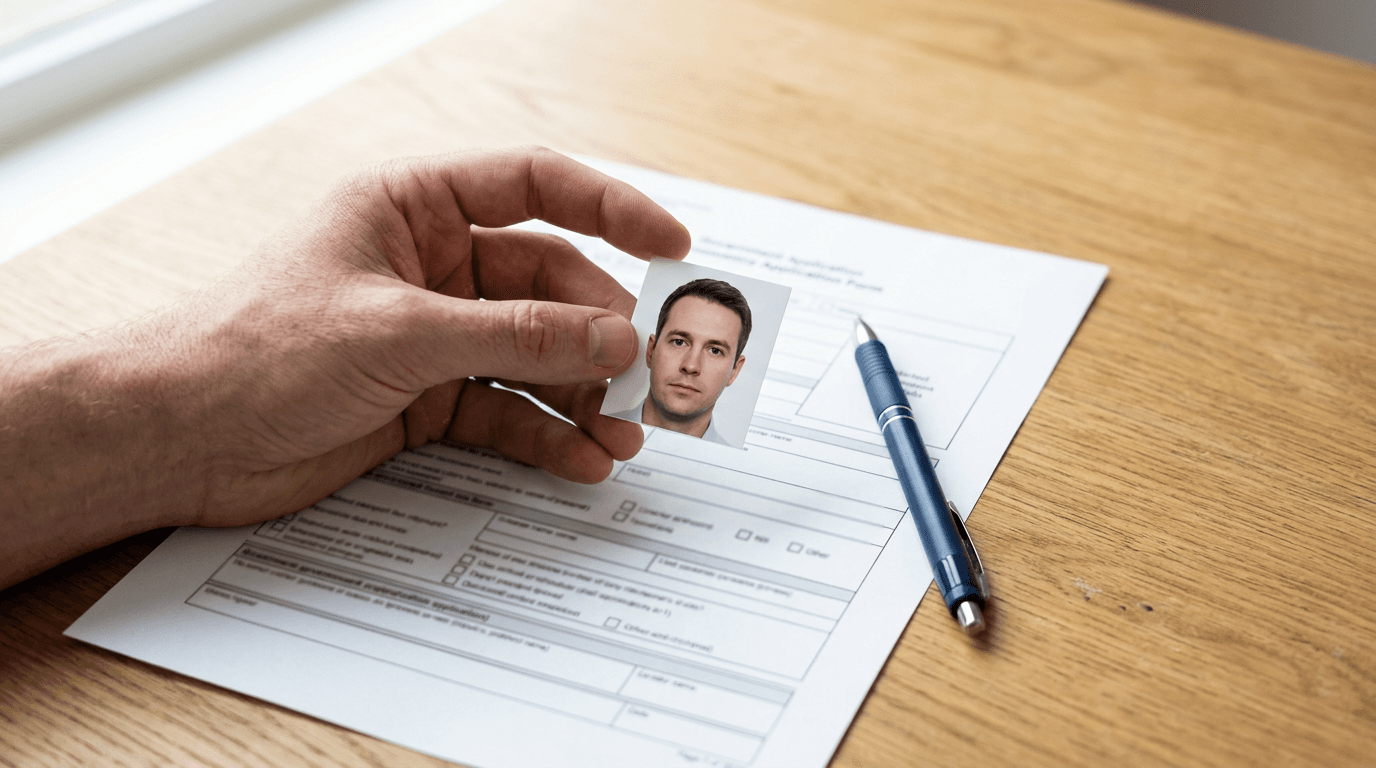
The temporary passport is assembled and printed directly at the desk of the Bürgeramt. Because the document is generated on-site, the municipal staff will not capture your photograph. You must arrive with a physical, printed photograph that meets strict biometric standards.

The mechanical requirements for German biometric photos are entirely uncompromising. The image must measure exactly 35x45 mm. The face must occupy the vast majority of the vertical space, spanning from the bottom of the chin up to the crown of the head. The background must be a light, unpatterned gray, providing high contrast to the subject's hair and face. The subject must maintain a neutral expression with a closed mouth, looking directly into the camera lens.
Parents face a particularly severe challenge when applying for emergency travel documents for infants. Securing a compliant shot of a newborn who cannot support their own head, inside a cramped supermarket photo booth, usually ends in failure. The automated booths reject the image, or the Bürgeramt official rejects the printout because the parent's hand is visible supporting the child. Reviewing a dedicated Germany baby passport photo guide helps clarify the exact tolerances officials allow for infants, such as slight deviations in eye contact, which are permitted for children under the age of ten.
Practical rule: Never cut the photo sheet yourself before arriving at the Bürgeramt; hand the official the full printed sheet so they can verify the 35x45 mm dimensions and crop it with their calibrated tool.
3. Navigate the Bürgeramt Emergency Appointment System
German municipal offices operate almost exclusively on strict appointment systems, with regular slots routinely booked out six to eight weeks in advance. Securing an emergency appointment requires bypassing the standard digital calendar and utilizing the municipality's triage protocols for urgent travel.
To access these emergency slots, you must prove that your departure is imminent. The primary mechanism is presenting non-refundable, paid travel documentation departing within the next 72 hours. A hotel reservation or an email stating you intend to drive across a border is rarely sufficient. You must provide flight tickets, train itineraries, or ferry bookings showing your name and the immediate departure date. In many major cities like Berlin or Munich, officials release canceled appointments back into the online system at exact times every weekday morning - often between 7:00 AM and 8:00 AM. Alternatively, calling the national public administration hotline (115) at exactly 8:00 AM can connect you with an operator who holds access to hidden emergency slots.
The most frequent error in this step is showing up at a Bürgeramt without a printed itinerary, expecting the triage desk to accept a booking confirmation viewed on a smartphone screen. Print it out. This is crucial. Municipal triage desks require physical paper trails to append to their daily logs when overriding the appointment queue. Arriving with only a digital ticket often results in being sent to a print shop down the street, costing you your place in the morning line.
4. Secure the Ersatz Reisepass and Temporary Documents
A temporary passport is strictly a stopgap measure, not a permanent solution. German authorities view it as an ersatz reisepass (replacement passport) strictly for an immediate crisis. Therefore, the administrative procedure forces you to address the long-term problem simultaneously.

When you sit down with the official to request the green temporary booklet, you are legally required to apply for your standard, permanent maroon biometric passport at the same time. The mechanisms involve capturing your fingerprints on a digital scanner, signing two distinct digital pads, and paying two separate fees. You will pay. This is mandatory. You pay the standard fee for the temporary document, which you will take home that day, plus the standard fee for the permanent passport (which has different tiers for applicants aged 24 and over versus those under 24), which will be mailed to the office in four to six weeks. The temporary document is issued with a maximum validity of one year, but you must surrender it when you pick up your permanent replacement.
A dangerous assumption travelers make is treating this temporary ersatz reisepass exactly like a standard passport. Because the document lacks the embedded RFID chip containing your biometric data, it is heavily restricted globally. If you attempt to board a flight to the United States using a temporary German passport, you will be denied boarding. The US strictly requires an e-chip for the ESTA visa waiver program. Travelers holding temporary passports must either apply for a traditional B1/B2 visa at a US consulate or review alternative compliance steps outlined in resources like a United States baby passport photo guide to expedite a permanent document instead.
5. Manage a Reisepass Abgelaufen Situation Before Travel
Discovering your travel document is intact but invalid presents a different bureaucratic path. When your reisepass abgelaufen status is the barrier to travel, you do not need to file a loss report or alert the police database. You simply need an immediate renewal.
The mechanics shift entirely based on exactly when your flight departs. If you have at least four to five business days before you travel, you do not need the green temporary document. Instead, you can request an Express-Reisepass. The Bundesdruckerei (Federal Printing Office) prioritizes these applications, manufacturing and shipping the permanent biometric passport back to your local Bürgeramt within 72 to 96 hours. This route incurs an express surcharge on top of the standard passport fee, but it yields a fully capable, 10-year biometric document that qualifies for ESTA and global visa waivers.
The mistake travelers make here is relying on the European Union's informal leniency. Certain EU countries legally accept German passports that have been expired for less than one year for border crossings. However, travelers rely on this diplomatic agreement and fail to check their airline's specific terms of carriage. Commercial airlines frequently enforce stricter rules than the destination country's border guards to shield themselves from liability, aggressively denying boarding to any passenger presenting an expired passport, regardless of EU grace periods.
6. Understand Why You Cannot Vorläufiger Reisepass Online Beantragen
Germany has expanded its digital government services under the Onlinezugangsgesetz (OZG), allowing citizens to register vehicles, apply for parental allowance, or request police clearance certificates digitally. However, securing a physical travel document remains a strictly analog requirement.
You cannot execute a vorläufiger reisepass online beantragen request because the Passgesetz dictates a secure, unbroken chain of identity verification. An official must look at your physical face, look at the printed biometric photograph, and visually confirm the match. They must witness your physical signature on the digital pad to prevent forgery, and for a permanent passport, they must physically capture your live fingerprints on an encrypted scanner. None of these security mandates can be fulfilled through a web portal or an email attachment.
The most damaging pitfall in this step is engaging with third-party scam websites that optimize for users attempting to apply online. Do not trust them. They are deceptive. These unauthorized portals charge steep service fees, promising to "process your emergency passport application online." In reality, these sites merely download the publicly available PDF of a loss report or use a bot to book a free appointment at your local Bürgeramt, offering no actual processing power while delaying your ability to secure the document directly.
Common Pitfalls and Troubleshooting
Navigating emergency passport bureaucracy often fails at the final hurdle. Recognizing exactly why a process stalled allows you to pivot before the flight departs.
The E-Chip Visa Denial
- Symptom: You arrive at the airport with your new green temporary passport, but the airline agent refuses to print a boarding pass for your flight to New York or Toronto.
- Cause: Temporary passports do not contain the biometric microchip required by electronic travel authorization systems like the US ESTA or the Canadian eTA. The airline's system automatically flags the document number as incompatible with a visa waiver.
- Fix: If you are heading to a destination requiring an e-chip, you cannot use a temporary passport for visa-free entry. You must either delay your flight and pay the express surcharge for an Express-Reisepass (delivered in 3-4 days) or secure an emergency consular visa appointment in your passport, which often takes longer than waiting for the express passport.
The Unverifiable Guardian
- Symptom: The Bürgeramt official refuses to accept the application for your infant's temporary passport, despite you having the baby, the photo, and the flight tickets present.
- Cause: By law, both custodial parents must consent to the issuance of a travel document for a minor to prevent cross-border child abduction. If one parent is absent and has not provided written consent and a physical ID card, the application is halted immediately.
- Fix: You must bring a signed, formal letter of consent (Zustimmungserklärung) from the absent parent, alongside their original physical ID card or passport (not a digital photo on a phone). If you have sole custody, you must present the official court order or the Negativbescheinigung from the youth welfare office proving it.
Infant Biometric Photo Rejection
- Symptom: The municipal worker glances at the printed photo of your baby and drops it back onto the desk, stating the background is too dark or the head proportions are skewed.
- Cause: Retail photo booths cannot calibrate lighting or adjust framing for an infant sitting in a car seat or lying down. The harsh flash creates heavy drop shadows, violating the biometric contrast rules.
- Fix: Do not attempt another photo booth. Use an AI-driven formatting tool designed specifically for biometric compliance, take the photo on a white blanket at home in natural light, and print the resulting sheet at a local pharmacy. Checking resources regarding EU & international baby passport photo requirements ensures the exact dimensions are met before you return to the desk.
The Federal Police Misunderstanding
- Symptom: You go to the Bundespolizei (Federal Police) desk at the airport two hours before your flight to Mallorca, but they tell you they cannot issue a temporary passport for your trip to Turkey.
- Cause: The Federal Police at the airport do not issue the green vorläufiger reisepass. They issue a separate, highly restricted paper document called a Reiseausweis als Passersatz. This document is only recognized by certain EU member states and a handful of other European nations. Turkey, among others, strictly refuses entry on this document.
- Fix: If your destination does not accept the Reiseausweis als Passersatz, you must leave the airport, secure an emergency appointment at the nearest municipal Bürgeramt, and apply for the actual green temporary passport, likely rebooking your flight for the next day.
FAQ
How fast can I get a temporary German passport?
If you have secured an emergency appointment at a Bürgeramt and brought a compliant biometric photograph and proof of identity, the official prints and hands you the temporary passport during that exact appointment. The physical production takes less than fifteen minutes.
Can I travel to the UK with a temporary German passport?
Yes. The United Kingdom accepts the green German temporary passport for entry at the border. However, because it lacks a biometric chip, you cannot use the automated eGates at UK airports; you must wait in line to be processed manually by a Border Force officer.
How much does a temporary German passport cost?
The fixed state fee for a temporary passport is €26. However, because you are required to apply for a permanent replacement simultaneously, you must also pay the standard passport fee of €70 (if 24 or older) or €37.50 (if under 24) during the same appointment.
What happens if I lose my passport abroad?
If you are outside of Germany, you must report the loss to the local foreign police and obtain a physical police report. You must then travel to the nearest German embassy or consulate, which will issue a temporary travel document specifically designed to allow you to re-enter Germany.